Willow Wars: making swipe timing feel fair
Cricket on a phone lives or dies on one moment: the swipe. If it feels random, nobody plays a second over.
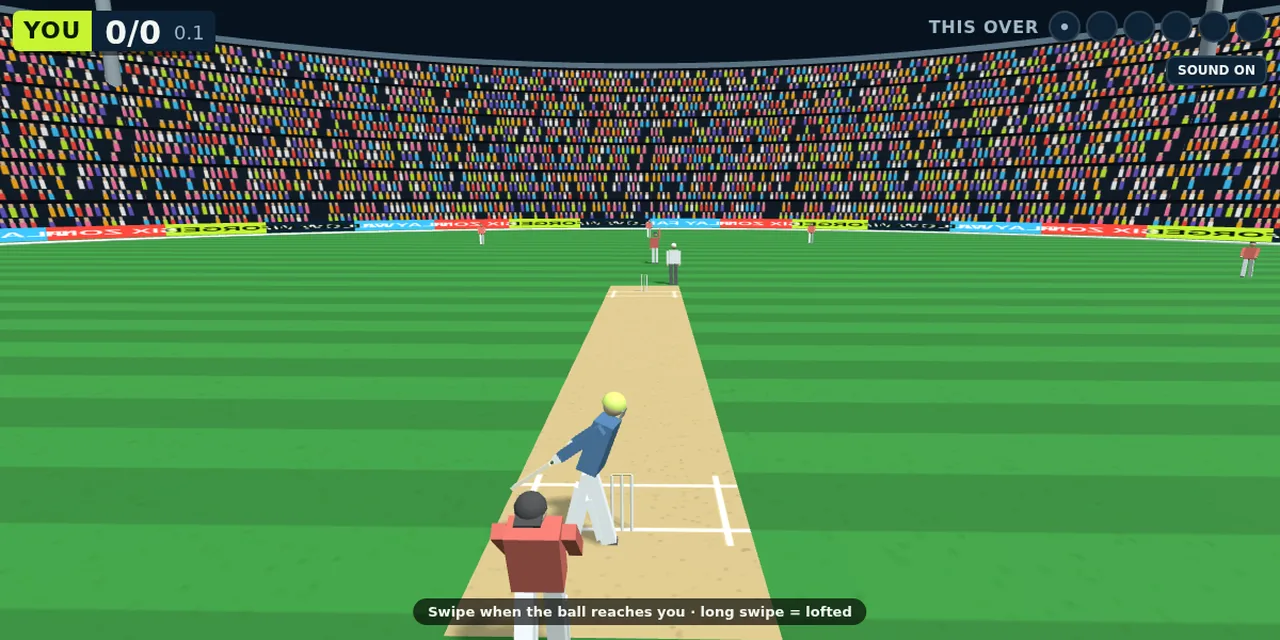
Grading the swipe
Each delivery has a planned moment when the ball reaches the bat. We compare your swipe to that moment. Within about 45 milliseconds is a Perfect hit, within about 90 is Good, and within about 150 is an Edge. Outside that, you miss. The windows are wide enough to feel fair on a touch screen and tight enough that a Perfect means something.
Direction and loft
The direction of the swipe aims the shot. Its length decides whether the ball stays on the ground or goes in the air. Lofted shots carry further but give fielders a chance to catch them, which is the same risk a real batter takes.
Fielders who actually field
Early builds gave almost no runs for ground shots because the ball rolled to a stop near the pitch. Now fielders move to cut off the ball's path, the ball rolls further on the outfield, and runs are counted from where the ball is finally stopped. Hit the gap and you get two; hit a fielder and you get one.
Bowling back
After your over, you bowl. You place a target on the pitch, choose fast, swing or spin, and stop a meter for accuracy. The bot bats with probabilities that depend on the difficulty level and how good your ball was.
A timing calculation with actual numbers
Using the approximate windows above, imagine the planned contact time is 1,000 ms. Compare the swipe's timestamp with that time and take the absolute difference. A swipe at 1,030 ms has a 30 ms error and belongs in the Perfect band. At 1,070 ms the error is 70 ms, inside Good but outside Perfect. At 1,120 ms it is 120 ms, inside Edge. At 1,180 ms it is outside the stated contact windows.
| Swipe time | Distance from 1,000 ms | Illustrative grade |
|---|---|---|
| 1,030 ms | 30 ms late | Perfect |
| 930 ms | 70 ms early | Good |
| 1,120 ms | 120 ms late | Edge |
| 1,180 ms | 180 ms late | Miss |
These examples explain the published approximate bands; they are not measurements from a recorded match. Values exactly on a band boundary are deliberately omitted here because the comparison operators and current build decide those edge cases.
Why timing and direction should be judged separately
A Perfect contact need not be a boundary. Contact quality describes when the swipe happened, while direction decides where the ball travels and swipe length decides the ground-or-air risk. A well-timed shot aimed toward a fielder can still be stopped. If every Perfect became six automatically, field placement and choosing a gap would matter much less.
That separation gives players a useful diagnosis. Repeated Edges suggest working on timing. Consistent contact followed by easy stops suggests looking at placement. Catches after long swipes suggest reconsidering loft. Each result points to a different decision rather than a single vague instruction to swipe harder.
What fair feedback needs to explain
A grade should help the player understand the next attempt. The timing label alone cannot explain every result: the fielder, direction and shot type also matter. A useful test sequence keeps direction and length similar while changing timing, then keeps timing similar while changing direction. This isolates the decisions instead of comparing two completely different shots.
Touch input and frame presentation also affect the experience. A player sees a rendered ball and responds through a device, so reports of inconsistent timing need the browser, device and delivery type. The numerical bands describe the grading idea; they do not prove that every phone displays and receives input with identical delay.
Try the practice-over drill in the guide to separate timing from placement. If the displayed grade contradicts what you see, send a short recording and device details through Contact.